

Are your advertising dollars disappearing into a black hole? You’re running ads on one platform, maybe dabbling in another, but the returns feel unpredictable and lackluster. If you’re tired of guessing which channels your customers actually use or worrying about your entire strategy depending on a single platform’s algorithm, it’s time for a more powerful approach. The problem isn’t a lack of effort; it’s a lack of a cohesive, results-driven plan. This is where a powerful media mix becomes your most valuable asset—the strategic blueprint that stops the guesswork and starts delivering measurable returns.
This guide is designed to cut through the jargon and give you a clear, actionable framework to elevate your advertising. You will learn precisely what a media mix is, why it’s non-negotiable for sustainable growth, and how to build a custom strategy for your business. We’ll show you how to combine the right channels to reach more of your ideal customers and finally 2X the impact of your advertising. It’s time to transform your ad spend from a frustrating expense into a high-performing investment that delivers consistent, cost-effective results.
What is a Media Mix? (Beyond the Marketing Jargon)
Think of your advertising budget as a high-performance investment portfolio. You wouldn’t put all your capital into a single stock; you diversify to manage risk and maximize returns. A media mix applies this same proven strategy to your marketing. It is the strategic combination of advertising channels you use to communicate with your target audience and drive growth.
The primary goal is to deliver the right message to the right person at the right time, through the most effective channel. This isn’t guesswork; it’s a calculated strategy, often refined through sophisticated statistical analysis like Marketing mix modeling to ensure every dollar spent delivers a measurable impact. A well-executed media mix ensures your message doesn’t just get seen—it gets results.
Media Mix vs. Marketing Mix: What’s the Difference?
It’s easy to confuse these terms, but the distinction is critical for strategic planning. The Marketing Mix is the foundational framework for your entire marketing effort, while the media mix is a tactical component within it.
**The Marketing Mix (The 4 Ps)**

This is your entire go-to-market strategy, encompassing:

    - **Product:** What you sell.

    - **Price:** How much it costs.

    - **Place:** Where customers can buy it.

    - **Promotion:** How you communicate its value.

**The Media Mix**

This is a crucial part of *Promotion*. It answers the questions: "Where will we advertise?" and "How will we allocate our budget across those channels?" (e.g., Google Ads, TV, social media, radio).
Why a ‘Mix’ is Better Than a Single Channel
Relying on a single advertising channel is a high-risk gamble. An algorithm change on a social media platform or a sudden cost increase in search ads can devastate your lead flow overnight. A diversified approach creates a more resilient and effective marketing engine.
The true power lies in synergy, where channels work together for a greater impact than they could alone. A potential customer might see your ad on Facebook (awareness), search for your brand on Google (consideration), and then see a retargeting ad that drives the final conversion. This multi-touchpoint strategy engages customers at every stage of their journey, transforming initial interest into profitable action.
The Core Components: Building Your Media Mix
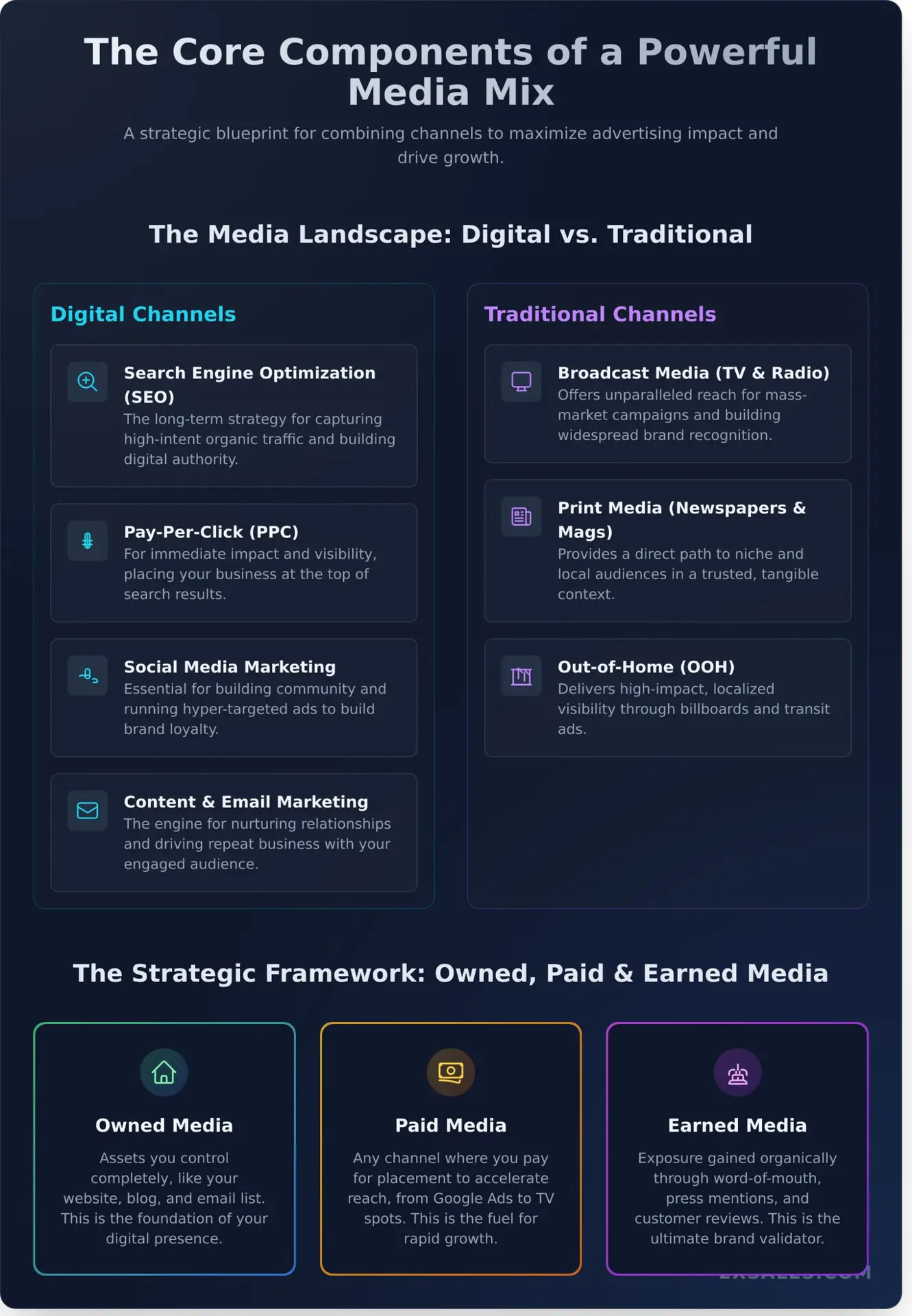
Crafting a powerful media mix requires a deep understanding of the modern marketing battlefield. The goal isn’t to be everywhere, but to be in the right places at the right time to connect with your target audience. Developing an effective media mix is about strategically allocating your investment across a blend of channels to maximize returns and ignite sustainable growth. Below, we break down the core components available to build your results-driven strategy.
Digital Advertising Channels
Digital channels offer unparalleled targeting and measurement, forming the backbone of most modern growth strategies. They provide direct access to customers and deliver real-time data to optimize performance.
Search Engine Optimization (SEO): The long-term strategy for capturing high-intent organic traffic. SEO builds your digital authority and delivers a consistent stream of qualified leads actively searching for your solutions.
Pay-Per-Click (PPC): For immediate impact and visibility. Platforms like Google Ads place your business at the top of search results, driving traffic and conversions from day one of your campaign.
Social Media Marketing: Essential for building community and running hyper-targeted ads. It allows you to connect with customers based on demographics, interests, and online behaviors to build brand loyalty.
Content & Email Marketing: The engine for nurturing relationships. High-value content establishes your expertise, while email marketing provides a direct line to your most engaged audience, driving repeat business.
Traditional Advertising Channels
While digital often takes the spotlight, traditional media still holds immense power for building broad brand awareness and reaching specific demographics that may be less active online.
Broadcast Media (TV & Radio): Offers unparalleled reach for mass-market campaigns, ideal for building widespread brand recognition and reaching audiences in a captive environment.
Print Media (Newspapers & Magazines): Provides a direct path to niche and local audiences, placing your brand in a trusted context for specific demographic segments.
Out-of-Home (OOH): Delivers high-impact, localized visibility through billboards and transit ads, reinforcing brand presence in key geographic markets.
Owned, Paid, and Earned Media Explained
Finally, it’s crucial to understand how these channels fit into a broader strategic framework. Every component falls into one of three categories:
Owned Media: Assets you control completely, like your website, blog, and email list. This is the foundation of your digital presence.
Paid Media: Any channel where you pay for placement to accelerate reach, from Google Ads to TV spots. This is the fuel for rapid growth.
Earned Media: Exposure you gain organically through word-of-mouth, like press mentions, customer reviews, and viral social shares. This is the ultimate brand validator.
How to Create a Media Mix Strategy for Your Local Business
Developing a powerful media mix doesn’t require a massive corporate budget. For a local business, it’s about making smart, strategic decisions to ensure every marketing dollar delivers a return. Think of it as building a results-driven blueprint for your advertising. This simple, four-step framework will help you allocate your budget effectively and ignite growth, whether you’re a plumber in Spokane or a retailer in North Idaho.
Step 1: Define Your Goals and Target Audience
Before you spend a single dollar, you must define what success looks like. Are you aiming for immediate leads (phone calls for service), broader brand awareness, or increased foot traffic? Simultaneously, define your ideal customer. Where do they live? What are their habits? A homeowner in their 40s who needs an emergency plumber consumes media very differently than a young renter. Answering these questions first is non-negotiable; it’s the foundation of a cost-effective strategy.
Step 2: Establish a Realistic Budget
Your marketing budget directly influences your channel selection. A common starting point for small businesses is allocating 5-10% of total revenue to marketing. This isn’t an expense—it’s an investment in future growth. A smaller budget may mean focusing on high-intent digital channels, while a larger one allows for a broader mix that includes traditional media. Be realistic, but treat your marketing budget as a critical operational investment.
Step 3: Select and Allocate to Your Channels
Now, match your channels to your audience. Where do your ideal customers spend their time? For a local service business, a potent starting mix often includes:
Local SEO: To capture customers actively searching on Google for "plumbers near me."
Google Ads: For immediate, top-of-page visibility for high-value keywords.
Local Radio: To build brand recognition and trust within the community.
Start with a few channels you can manage exceptionally well. For a deeper dive into all the components that can make up your strategy, this comprehensive guide to media mix from HubSpot provides an excellent overview. The key is to create a synergistic effect where each channel supports the others.
Step 4: Measure, Analyze, and Optimize
A successful media mix is never "set it and forget it." It is a dynamic strategy that requires constant evaluation. Track key performance indicators (KPIs) for each channel, such as Cost Per Acquisition (CPA), Return On Ad Spend (ROAS), and website traffic. If you see that Google Ads are generating leads at a much lower cost than your radio spots, it’s time to reallocate your budget. This continuous optimization process ensures your investment is always working as hard as possible to generate results.
Feeling overwhelmed? That’s where expertise makes the difference. Let our experts build a results-driven media mix for you .
The Future of Media Mix: Modeling and Optimization
Once you have established a diverse marketing strategy, the next frontier is true optimization. For businesses with significant investments across multiple channels, guesswork isn’t a viable strategy—data is. This is where Media Mix Modeling (MMM) transforms your approach from simply being present everywhere to strategically allocating every dollar for maximum impact.
MMM is a sophisticated, data-driven analysis that expert agencies use to dissect campaign performance and maximize ROI. It moves beyond surface-level metrics to provide a clear, statistical picture of how each component of your marketing efforts contributes to your ultimate goal: driving sales and shattering growth targets.
What is Media Mix Modeling (MMM)?
Media Mix Modeling is an advanced analytical technique that uses historical data, such as sales figures and marketing spend, to quantify the impact of your advertising activities. It answers critical business questions like, “How much did our recent TV campaign actually contribute to Q4 revenue?” or “What is the real return on our influencer marketing investment?”
Unlike basic attribution, a robust MMM also accounts for external factors that influence sales, including seasonality, economic conditions, and even competitor promotions. This provides a holistic and accurate view of what truly drives your growth.
When Should Your Business Consider MMM?
While powerful, MMM is an advanced solution best suited for businesses that have reached a certain scale. It’s time to elevate your strategy and consider modeling when:
You are running multiple, concurrent campaigns across several digital and traditional channels.
You need to confidently justify a significant marketing budget to executives or investors with hard data.
You want to accurately forecast the sales impact of future budget shifts before you commit a single dollar.
Effectively leveraging your media mix at this level requires deep expertise to ensure your investment delivers results. We use advanced strategies to 2X your sales. See how we do it.
Ignite Your Growth with a Smarter Media Mix
Understanding your advertising is no longer about just picking channels; it’s about building a strategic framework where every dollar works harder. As we’ve covered, a well-crafted media mix integrates the right combination of digital and traditional platforms, tailored specifically to your local audience. The key to sustained growth lies in leveraging data and ongoing optimization to ensure your marketing investment delivers maximum impact.
But turning theory into tangible results requires expertise. At 2X Sales, our team of local experts serving Spokane and North Idaho brings decades of media buying experience to the table. We don’t guess—we build proven strategies designed for one purpose: delivering measurable ROI.
Ready to build a results-driven plan that can double your sales? Schedule Your Free 1-Hour Strategy Consultation. Your next level of growth is just one strategy session away.
Frequently Asked Questions
What is a good media mix for a small local business?
For a local business, a results-driven mix starts with a strong digital foundation: Google Business Profile optimization, local SEO, and geo-targeted Google and Facebook Ads. This captures immediate local demand. To expand reach, consider cost-effective traditional channels like sponsoring a community event or targeted direct mail to high-value zip codes. The goal is to maximize visibility where your local customers are actively searching and living, ensuring every dollar of your investment drives tangible growth.
How often should you review and adjust your media mix?
A comprehensive review of your media mix should be conducted quarterly. This allows enough time to gather meaningful performance data, but you should monitor campaign metrics weekly to make tactical adjustments. Major market shifts, new competitor strategies, or a significant product launch may also trigger an immediate review. A proactive, data-driven approach ensures your advertising investment is always optimized for maximum return and never becomes stagnant. This is not a "set it and forget it" strategy.
Is traditional media like radio and print still effective in 2026?
Yes, traditional media remains a powerful tool when used strategically, not as a blanket solution. Its effectiveness depends entirely on your target audience. A local magazine can be highly effective for reaching an affluent, niche demographic, while a targeted radio ad can dominate a specific commuter audience. The key is precision. When integrated with digital campaigns and tracked with unique promo codes or landing pages, traditional channels can deliver a significant, measurable return on your investment.
How do you measure the ROI of a complex media mix?
Measuring a complex media mix requires a unified tracking strategy. For digital channels, use UTM parameters to track clicks and conversions in Google Analytics. For traditional ads, implement unique phone numbers, dedicated landing pages, or specific offer codes. By funneling all this data into a central analytics platform, you can accurately attribute leads and sales to each channel. This provides a clear picture of your return on ad spend (ROAS) and informs future budget allocation decisions.
What’s the difference between a media mix and a media plan?
Think of the media mix as the "what" and the media plan as the "how." Your media mix is the strategic combination of advertising channels you use—for example, SEO, social media ads, and radio. The media plan is the detailed tactical document that outlines how you will execute that mix. It specifies budgets for each channel, campaign timelines, target audiences, specific platforms or publications, and the key performance indicators (KPIs) used to measure success.
How much of my budget should I spend on digital vs. traditional media?
There is no universal percentage. The ideal budget allocation depends entirely on where your target audience spends their time and engages with content. A business targeting Gen Z might invest 95% in digital channels like TikTok and Instagram. Conversely, a company serving seniors may find a 50/50 split with print and radio more effective. The most pragmatic strategy is to start with audience research and test channels, then shift your investment based on performance data to maximize your return.
Add a Comment