

Trying to pin down the cost of a new business website can feel like navigating a maze blindfolded. You see quotes ranging from a few hundred dollars to tens of thousands, with no clear explanation for the massive price gap. This huge variance in the average website design cost leaves business owners confused, frustrated, and worried about hidden fees. Are you paying for essential features that drive growth, or are you just funding an expensive digital business card that generates zero leads?
Forget the guesswork and ambiguity. This guide is your definitive roadmap to understanding website pricing in 2026. We will provide a transparent breakdown of what truly drives the final cost, transforming your perspective from seeing a website as an expense to recognizing it as a strategic investment. You will get a clear checklist of value-driven features and gain the confidence to evaluate any quote like a seasoned expert. It’s time to stop overpaying and start investing in a powerful sales asset designed to deliver a measurable return.
Decoding Website Costs: It’s an Investment, Not an Expense
Before we dive into numbers, let’s establish a critical mindset shift. Your website isn’t a line-item expense like office supplies; it’s your most powerful, tireless sales engine, working 24/7 to attract, engage, and convert customers. This is why the website design cost can range from a $500 template to a $50,000+ custom-built platform. You aren’t just buying code and images. You’re investing in a strategic asset designed to generate a significant return.
The True Cost of a ‘Cheap’ Website
Opting for a rock-bottom price often creates a costly liability. A $500 website typically translates to lost opportunities from non-existent SEO, a frustrating user experience that repels potential clients, and zero lead generation. Worse, these sites are frequently built on insecure foundations, making them prime targets for hackers. The cost to repair a compromised site and a damaged reputation far exceeds the initial “savings.”
Core Components of a Professional Website Build
A results-driven website is built on four essential pillars. Understanding these components is key to deciphering any professional website design cost proposal. Throughout this guide, we will break down the investment required for each:
- Strategy & Planning: This is the blueprint. We translate your specific business goals—more leads, higher sales, better brand authority—into a concrete digital strategy before a single pixel is designed.
- Design & UX: More than just aesthetics, this is the science of creating a brand-aligned, conversion-focused user experience. It encompasses everything from visual identity to the strategic placement of calls-to-action, covering the many disciplines involved in what web design entails.
- Development & Coding: Here, the design is brought to life. Professional development ensures your website is fast, mobile-responsive, secure, and built on a reliable foundation that can scale with your business.
- Content & SEO: This is the fuel for your sales engine. Strategic content and foundational Search Engine Optimization (SEO) are what attract qualified traffic from Google and persuade visitors to take action.
Website Cost Tiers: What to Expect at Every Price Point
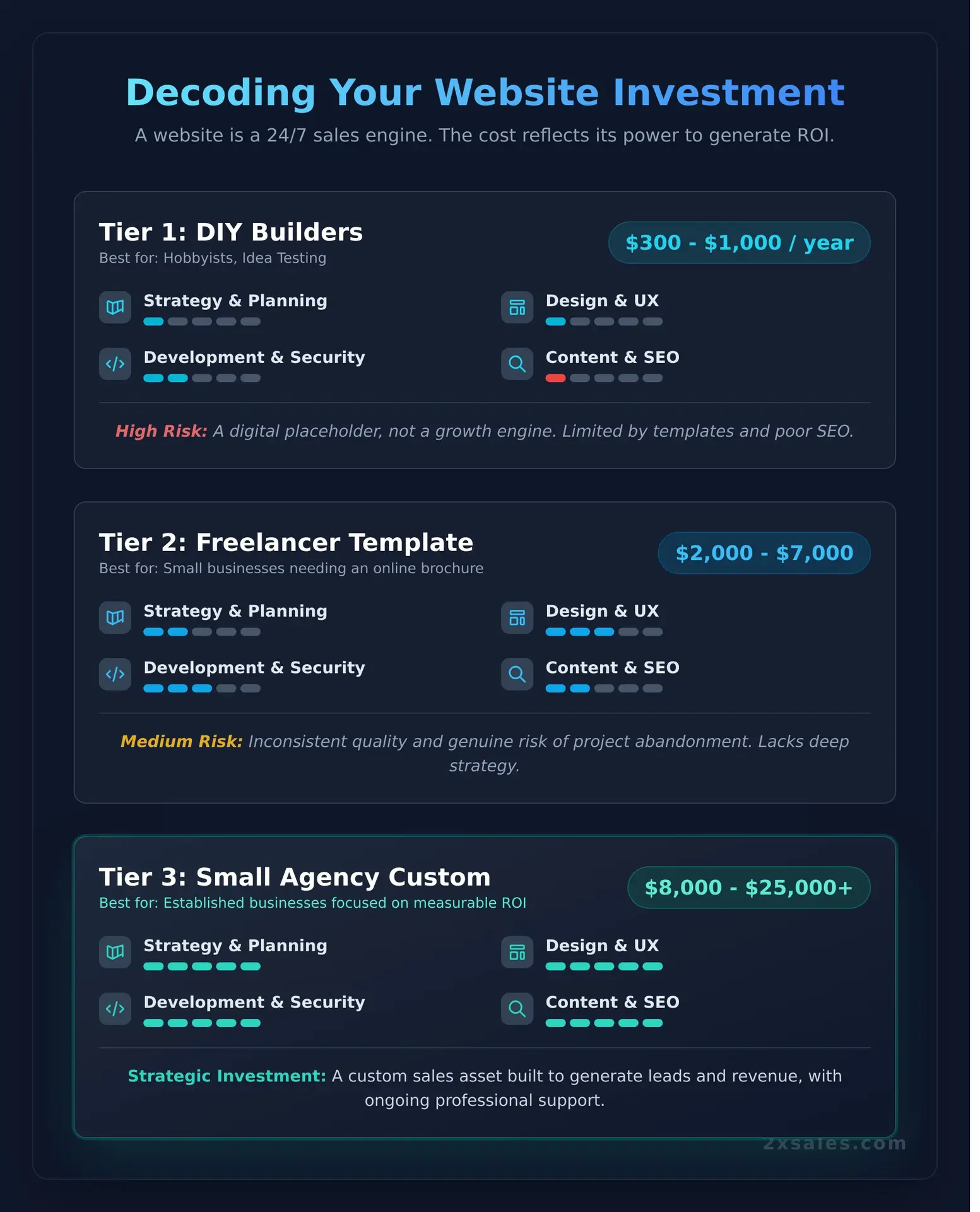
Understanding your website cost is not about finding the cheapest price tag; it’s about defining the return on your investment. The right solution depends entirely on your business stage and growth objectives. To help you navigate this critical decision, we’ve broken down the typical investment levels. Major business publications like Forbes also offer detailed analysis on how much a website costs, confirming that the price directly correlates with the strategic value and features you receive.
Tier 1: DIY Website Builders ($300 – $1,000 / year)
Platforms like Wix and Squarespace offer a low-cost entry point, ideal for hobbyists or brand new ventures testing an idea with a minimal budget. However, this approach comes with significant trade-offs. You are limited to generic templates, minimal customization, and critically, poor SEO capabilities that will leave you invisible to search engines. It’s a digital placeholder, not a growth engine.
Tier 2: Freelancer Template Customization ($2,000 – $7,000)
This tier involves hiring a freelancer to customize a pre-built theme. It’s a viable step up for small businesses needing a professional online brochure. The risk, however, is inconsistency. You might get a decent design, but it often lacks an underlying marketing strategy. Quality varies wildly, and there’s a genuine risk of project abandonment, leaving you with an unfinished or unsupported site.
Of course, finding the right freelancer or building an in-house team is a major step that goes beyond the website itself. As your business grows, you’ll need to find talent for various roles. For a look at how companies are attracting skilled professionals, it’s helpful to check out Alpha.jobs and see what the market looks like.
Tier 3: Small Agency Custom Design ($8,000 – $25,000+)
This is where a website transforms from an expense into a strategic asset. Partnering with a results-driven agency like 2X Sales means you’re investing in a custom-designed WordPress site built for one purpose: generating leads and revenue. This tier is for established businesses focused on measurable ROI. The entire process is built on a foundation of strategy, including:
- An SEO-first approach to capture high-value organic traffic.
- Conversion rate optimization (CRO) to turn visitors into customers.
- Professional, ongoing support to ensure peak performance and security.
Here, the website design cost is a direct investment in a powerful sales tool designed to scale with your ambition.
7 Key Factors That Drive Your Final Website Price
A business website is not a commodity; it’s a strategic asset tailored to your specific goals. The final price tag is a direct reflection of the complexity and customization required to achieve those goals. Think of this section as a pre-flight checklist for your project. The U.S. Small Business Administration advises you to Calculate your startup costs with your website as a key line item, and understanding these drivers is the first step. Being prepared to discuss these points ensures you get a precise quote and a website built to deliver results.
1. Number of Pages and Overall Scope
A simple 5-page brochure site is fundamentally different from a 50-page corporate site with deep service sections. More pages mean more design hours, more content development, and a more complex navigation structure. Furthermore, the cost increases with the number of unique page layouts required. A site where every service page has a custom-designed layout will be a larger investment than one using a single, repeated template.
2. Custom Design vs. Template
A template-based site can be launched quickly and at a lower initial cost, but you’re often limited by its pre-built structure and generic feel. A custom design, on the other hand, is a digital extension of your brand, engineered specifically for your target audience’s journey. This tailored approach directly impacts user experience (UX) and conversion rates, transforming your site from a simple online presence into a powerful sales tool.
3. E-commerce and Special Functionality
Need to sell products online? Adding e-commerce functionality with a shopping cart, secure payment gateway, and inventory management is a significant cost factor. The same applies to other special features that require custom development, such as:
- Appointment booking and scheduling systems
- Interactive cost calculators or quoting tools
- Secure client login portals for document sharing
- Integrations with your CRM or email marketing software
4. Content Creation and SEO
The largest variable in many projects is content. Will you provide all professionally written text and high-resolution images, or does your agency need to create them? Professional copywriting ensures your message is clear, persuasive, and optimized for search engines. A critical part of any modern website design cost is the foundational technical SEO setup—this includes site architecture, mobile responsiveness, and schema markup—which is essential for getting found on Google from day one.
Beyond the Launch: Planning for Ongoing Website Costs
A common mistake is viewing a new website as a one-time project. In reality, a high-performance website is a living business asset, and the initial website design cost is only the first part of the investment. To protect that investment and generate a powerful return, you must factor recurring costs into your annual marketing budget. Failing to maintain and grow your site is like buying a new delivery truck and never paying for fuel or oil changes—it quickly becomes a useless liability.
A professional agency doesn’t just build a website; we build a foundation for growth. Here’s how to budget for post-launch success.
Essential Maintenance Costs ($50 – $500+ / month)
These are the non-negotiable operational costs required to keep your digital asset secure, online, and functional. Think of this as the essential upkeep that protects your core investment from depreciation and threats.
- Web Hosting & Domain: This is the digital “rent” for your website’s address (your URL) and the server space it occupies. Quality hosting is critical for site speed, reliability, and user experience.
- Security & Backups: Proactive security monitoring, malware scanning, and regular off-site backups are not optional. They are your insurance policy against catastrophic data loss and cyber attacks that could cripple your business.
- Software Updates: For platforms like WordPress, consistent updates to the core software, plugins, and themes are vital for patching security vulnerabilities and ensuring every feature works seamlessly.
Growth and Marketing Costs (Variable)
While maintenance keeps your site running, growth activities are what turn it into a lead-generation engine. This is where you actively invest to increase visibility, traffic, and conversions. This budget is variable and should be tied directly to your business growth objectives.
- Ongoing SEO: Search Engine Optimization is a continuous strategy, not a one-time fix. It requires persistent effort in content creation, technical optimization, and authority building to climb and maintain high rankings on Google.
- Content Marketing: Creating regular, high-value content like blog posts and case studies establishes your authority, attracts qualified visitors, and fuels your entire SEO strategy.
- Digital Advertising (PPC): Pay-per-click campaigns drive immediate, targeted traffic to your site, perfect for generating leads quickly or promoting specific offers.
Smartly allocating a budget for both maintenance and marketing is what separates a static online brochure from a dynamic sales machine. This ongoing strategy is just as critical as the initial website design cost. To transform your website from an expense into a primary driver of revenue, you need a proactive growth plan. Ask us about our results-driven SEO plans.
How to Get an Accurate Quote for a Website That Drives Sales
Understanding the true investment for a new website goes far beyond a simple price tag. A quote should be the outcome of a strategic conversation, not a number you receive after a five-minute phone call. If an agency gives you a price without a thorough discovery process, consider it a major red flag. They are selling you a commodity, not a results-driven business asset.
A professional partner understands that your website is a critical sales and marketing engine. Therefore, the initial conversation should focus on your business goals, target audience, and revenue objectives. This dialogue ensures the final website design cost is directly tied to the value and return on investment it will generate for your company.
Preparing for Your Consultation
To get the most accurate proposal, you must arrive prepared. Before speaking with any agency, have a clear vision for what success looks like. This preparation empowers you to guide the conversation and helps the agency architect a solution tailored to your specific needs. Come ready with:
- Defined Business Goals: What must this website achieve? (e.g., “Generate 20 qualified leads per month,” or “Increase online course sales by 30%.”)
- Competitor Analysis: A list of 3-5 competitor websites you admire and, just as importantly, why you admire them.
- Target Audience Profile: A clear understanding of who your ideal customer is, including their pain points and motivations.
Evaluating a Web Design Proposal
A quality proposal is a strategic blueprint, not just an invoice. When you receive a document, look past the final number and scrutinize the details. A proposal from a serious agency will connect every feature and deliverable back to your business goals. It should clearly outline the process, the project timeline, and who you will be working with. Avoid single-line items; demand a detailed breakdown that justifies the investment and sets clear expectations for the partnership.
Ultimately, a precise quote for your website design cost is a reflection of a well-defined strategy. It’s about building a powerful tool engineered to grow your business. Ready for a strategic approach? Schedule a free consultation.
Turn Your Website Investment into Your #1 Sales Engine
As we’ve explored, determining your website’s price in 2026 is about shifting your mindset from expense to strategic investment. The key takeaways are clear: a website is not a one-size-fits-all product, and its final cost is directly tied to the features required to achieve your specific business goals. Ultimately, the right website design cost is the one that delivers a powerful return and fuels your growth for years to come.
Don’t settle for a generic digital brochure when you can have a high-performance sales asset. At 2X Sales, we leverage decades of experience in Spokane and North Idaho to build websites that convert. Our proven process is focused on ROI, integrating expert WordPress development with powerful SEO from the very first line of code. Ready to see what a strategic approach can do for your bottom line?
Get a Strategic Quote to 2X Your Sales and let’s build the powerful online presence your business deserves.
Frequently Asked Questions About Website Costs
How long does it take to build a business website?
A standard business website of 5-10 pages typically requires 4-8 weeks from our initial strategy session to final launch. This timeline allows for comprehensive discovery, design, development, and content integration. More complex projects involving e-commerce or custom functionalities will require a longer development window. Our results-driven process ensures we deliver a high-performance asset on a clear, pre-defined schedule to maximize your investment’s return and get you to market faster.
Do I have to pay for web hosting and a domain name separately?
Yes, your domain name (e.g., YourBusiness.com) and web hosting are separate, recurring investments essential for your online presence. The domain is your digital address, and hosting is the service that keeps your site live on the internet. While some agencies bundle these, we believe in transparency. We guide you in securing cost-effective, high-performance solutions directly, giving you full ownership and control over these critical business assets from day one.
What is the average hourly rate for a professional web designer in 2026?
In 2026, the average hourly rate for a professional web designer or agency ranges from $100 to $250+. This variance in website design cost reflects the designer’s experience, specialization, and the complexity of the solutions provided. At 2X Sales, we prioritize project-based pricing to deliver clear value and a predictable investment. This approach ensures your budget is tied directly to tangible results and business growth, not just billable hours.
Why do you build websites on WordPress?
We build on WordPress because it offers the ultimate combination of power, flexibility, and scalability—critical for any results-driven digital strategy. It powers over 43% of the web for a reason. This platform allows for robust SEO implementation, seamless integration with essential marketing tools, and empowers you, the business owner, to manage your own content. It’s not just a website; it’s a strategic marketing asset built for long-term growth and market dominance.
What is the difference between web design and web development?
Think of web design as the architecture and interior design of your digital storefront—it focuses on user experience (UX) and visual aesthetics (UI). Web development is the construction and engineering that brings that blueprint to life. Developers write the code that makes the site functional, interactive, and secure. Our agency integrates both disciplines seamlessly, ensuring your website is not only visually compelling but also a high-performance engine for converting visitors into customers.
Will I be able to update the website myself after it’s launched?
Absolutely. We believe in empowering our clients. Every website we build is on a user-friendly Content Management System (CMS) like WordPress, designed for easy updates. Upon launch, we provide comprehensive training so you can confidently manage content like blog posts, text, and images. This ensures your website remains a dynamic and current asset for your business, allowing you to adapt your marketing message without incurring additional costs for minor changes.
Add a Comment