

Is your boss convinced your current website is “good enough”? You see the high bounce rates, the poor conversion numbers, and the outdated user experience, but the conversation stalls when you can’t connect those issues directly to the bottom line. Arguing that “it looks old” is not a compelling business case. The real challenge is learning how to justify a website redesign using the language decision-makers understand: data, revenue, and return on investment.
This guide is your strategic blueprint. We will show you precisely how to move beyond subjective feedback and build an undeniable, data-driven argument for a new website. You’ll discover the critical performance metrics that prove your current site is costing you money, learn how to forecast the financial uplift of a redesign, and gain the confidence to secure the budget you need. It’s time to transform your website from a simple brochure into a results-driven sales engine that elevates your brand and delivers measurable growth.
Key Takeaways
- Move beyond subjective opinions by conducting a deep performance audit to pinpoint specific, data-backed weaknesses in your current website.
- Learn to translate website analytics into the language of C-suite executives by directly linking performance issues to lost revenue and missed opportunities.
- Master how to justify a website redesign by leveraging key business triggers, such as a rebrand or new product launch, to create an undeniable case for investment.
- Structure a persuasive business case that shifts the conversation from past failures to future ROI, securing the budget and executive buy-in you need.
Step 1: Audit Your Current Website’s Performance to Find the Flaws
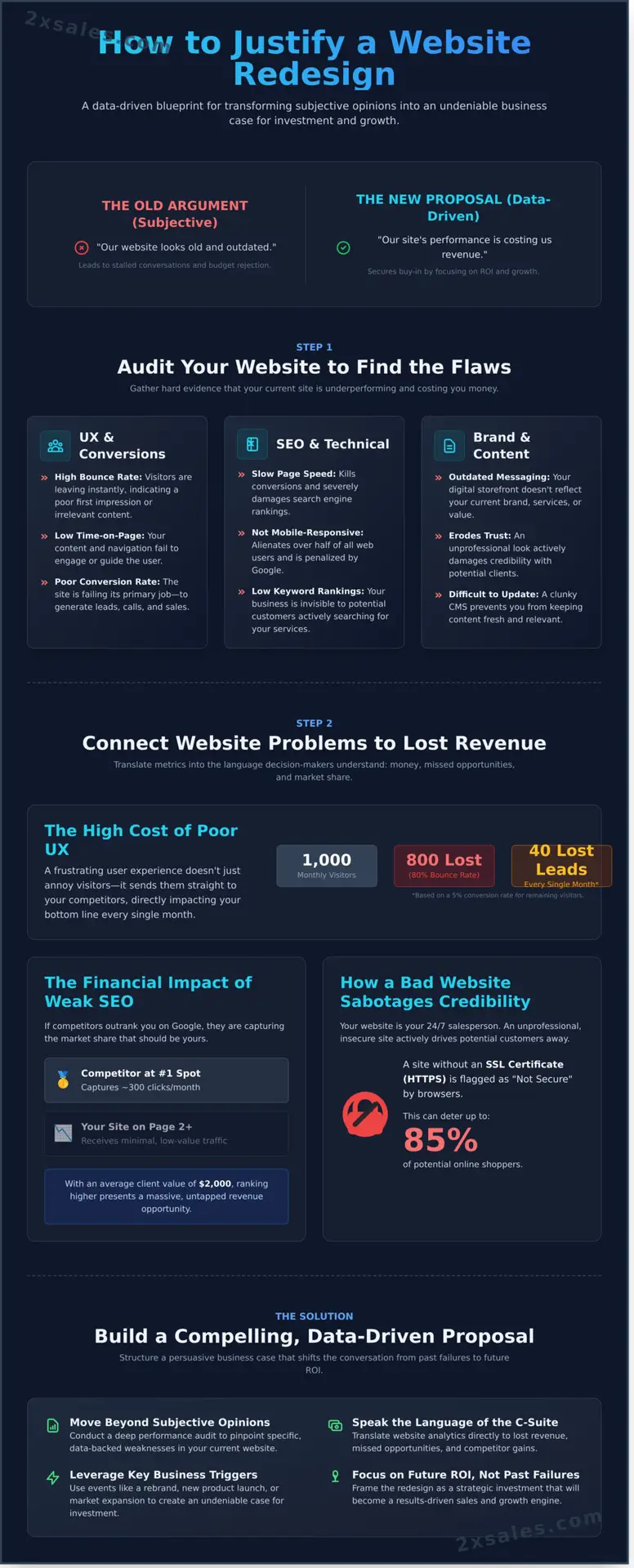
To successfully justify a website redesign, you must move beyond subjective feedback like “it looks dated.” The foundation of your business case isn’t opinion; it’s objective data. This initial audit is where you gather the hard evidence that proves your current site is underperforming and costing you revenue. By focusing on metrics, you transform a request into a strategic, results-driven investment.
For a clear overview of how data builds your case, watch this short video:
How to Justify a Website Redesign When Poor UX Is Costing You Sales
Your website exists to drive action. Is it succeeding? Dive into Google Analytics to uncover the truth. A high bounce rate indicates visitors are leaving instantly, while low time-on-page suggests your content isn’t engaging. Most importantly, track your conversion goals. If contact forms, quote requests, or phone calls are stagnant, your site’s UX is failing. Tools like heatmaps can visually show you exactly where users are getting stuck or dropping off.
Evaluate SEO and Technical Performance
A modern website must be technically sound to compete. Use Google’s PageSpeed Insights to test your site’s load time on mobile and desktop-slow speeds kill conversions and hurt search rankings. Is your site mobile-responsive? A non-mobile-friendly design is a dealbreaker for both users and Google. Auditing your keyword rankings will show if you’re even visible for valuable search terms. This technical deep-dive is a core part of the web design process, as it identifies foundational issues like broken links and 404 errors that frustrate users and damage your SEO authority.
Assess Brand Alignment and Content
Your website is your digital storefront. Does it accurately reflect your current brand, services, and value proposition? Outdated messaging, old product photos, or a difficult-to-update content management system (CMS) all signal a disconnect. This misalignment doesn’t just look unprofessional; it actively erodes trust and credibility with potential clients. Proving that your site is a poor brand ambassador is a powerful part of learning how to justify a website redesign.
Step 2: Connect Website Problems to Lost Revenue and Opportunities
The data from your website audit is a powerful tool, but numbers alone don’t secure a budget. To get executive buy-in, you must translate those metrics into the language decision-makers understand: money. This step is the core of how to justify a website redesign, shifting the conversation from a creative expense to a strategic, results-driven investment. Your goal is to demonstrate that the current website isn’t just underperforming-it’s actively costing the business revenue and suppressing growth.
The High Cost of Poor User Experience
A frustrating user experience (UX) directly impacts your bottom line. Consider a key service page with a high bounce rate. If that page gets 1,000 visitors per month with an 80% bounce rate, that’s 800 potential customers leaving without taking action. If your site’s conversion rate is 5%, you are losing a potential 40 qualified leads every single month from that page alone. Confusing navigation and a cluttered layout don’t just annoy users; they send them straight to your competitors. A professional WordPress web design is engineered to streamline these user journeys, turning frustrated visitors into valuable leads.
The Financial Impact of Weak SEO
If your competitors consistently outrank you on Google, they are capturing the market share that should be yours. An outdated site architecture, slow load times, and a poor mobile experience are all major red flags for search engines, leading to lower rankings and diminished visibility. Calculate the value of that lost traffic. If the top search result for your primary service gets an estimated 300 clicks per month and your average client value is $2,000, you are forfeiting a significant revenue opportunity. A modern, SEO-optimized site structure is fundamental to reclaiming that lost ground and driving organic growth.
When Your Website Sabotages Sales and Credibility
Your website is your company’s digital storefront and its most powerful salesperson, working 24/7. What message is it sending? An unprofessional design can make high-value services feel cheap, eroding trust before a conversation even begins. Furthermore, critical security flaws have a tangible impact; a site without an SSL certificate (HTTPS) can deter up to 85% of potential shoppers. If your content management system is so archaic that you can’t easily add new case studies or service offerings, you are missing out on vital marketing opportunities. The most effective way to understand how to justify a website redesign is to ask: is your 24/7 salesperson closing deals or driving customers away?
This is especially true for online stores, where the digital experience is the entire business. Partnering with a specialized team, such as an agenzia sviluppo ecommerce, can be the difference between a thriving online business and a failing one, as they focus specifically on turning visitors into paying customers.
Step 3: Identify Key Business Triggers for a Redesign
While the previous steps focused on building a case with performance data, sometimes the need for a redesign is driven by major business changes. These triggers are not subtle; they are clear, undeniable events that make your current website a liability rather than an asset. When these situations arise, they form the foundation of a successful strategy for website redesign by creating an irrefutable case for investment. If any of the following apply to your business, your path to approval just became much simpler.
Your Website Isn’t Mobile-Responsive
In today’s market, a non-responsive website is a critical failure. Which is a good way to justify a website redesign. This isn’t a minor cosmetic issue-it’s a fundamental breakdown of your digital strategy that directly impacts revenue. Consider these facts:
- Market Access: With over 60% of all web traffic coming from mobile devices, a poor mobile experience is like closing your doors to the majority of your potential customers.
- SEO Penalties: Google uses mobile-first indexing, meaning it primarily ranks your site based on its mobile version. A clunky, slow, or broken mobile site will directly harm your search engine rankings.
- User Experience: A frustrating mobile experience leads to high bounce rates and lost conversions, damaging both your reputation and your bottom line.
How to Justify a Website Redesign During Rebrands, Expansions, and Market Shifts
Your website is your digital storefront and the primary representation of your brand online. When your business evolves, your website must evolve with it. A redesign becomes non-negotiable if you have recently undergone a rebrand, shifted your core messaging, or launched new products or services. An outdated site that reflects your old identity creates brand confusion, erodes customer trust, and weakens your competitive position. This is a critical moment to align your digital presence with your new business direction and capitalize on the momentum of your strategic changes.
A prime example of a strategic shift is expanding into international markets. A redesign in this case isn’t just about a new look; it’s about building a multilingual platform to connect with a global audience. For companies taking this step, it’s crucial to ensure content is accurately and professionally translated. To see how a dedicated service handles this for major brands, you can learn more about Translators USA.
Your Technology is Obsolete
An aging tech stack doesn’t just look dated; it actively holds your business back and exposes you to risk. This is one of the most compelling arguments when learning how to justify a website redesign because it impacts security, efficiency, and future growth. Your technology is obsolete if:
- It’s built on outdated platforms (like Flash) or unsupported code.
- It cannot integrate with modern marketing tools like your CRM, analytics platforms, or automation software.
- Your team wastes hours on simple content updates that should take minutes.
- It has known security vulnerabilities, putting your company and customer data at significant risk.
Step 4: Build and Present a Compelling Proposal
You have gathered the data and identified the critical issues. The final step is to synthesize this information into a persuasive business case. A powerful proposal shifts the conversation from “cost” to “investment” by focusing on future opportunity, not just past failures. Your goal is to present a logical, data-driven argument that makes ‘yes’ the only sensible answer.
Define Clear Goals and Measurable KPIs
Vague objectives like “a better website” will not secure a budget. To get approval, you must define exactly what success looks like with concrete metrics. This demonstrates a strategic, results-driven plan and sets the benchmarks for measuring the project’s ultimate success.
- Increase Qualified Leads: Target a 30% increase in marketing qualified leads (MQLs) within 12 months.
- Reduce Bounce Rate: Aim to decrease the overall site bounce rate by 25% to improve user engagement.
- Improve SEO Performance: Elevate primary service keywords into the top 5 positions on search engine results pages (SERPs).
Estimate the Return on Investment (ROI)
This is the most critical element of how to justify a website redesign. You must translate your performance goals into clear financial terms. Project the revenue increase from achieving your new lead and conversion rate targets over 12-24 months. Compare this potential gain against the estimated project cost to calculate a clear ROI. A strong positive return transforms the redesign from an expense into a profit-generating initiative.
Beyond the numbers, the visual and creative direction of the redesign plays a crucial role in brand perception and user engagement. For a look at how a professional team handles the creation of compelling visual assets for businesses, you can check out DesignEdge.
Partner with an Agency to Strengthen Your Case
Leveraging a professional agency adds immense credibility to your proposal. An expert audit provides an objective, data-backed foundation for your arguments. An agency can also supply a detailed project scope, a realistic timeline, and a portfolio of results. Pointing to an agency’s past projects provides tangible proof of what’s possible and shows stakeholders you’ve done your due diligence. This strategic partnership is often the key to building an undeniable case for investment.
From Proposal to Profit: Finalizing Your Case for a Redesign
You now have a strategic framework for success. The key to how to justify a website redesign is to move beyond aesthetics and anchor your argument in hard data. By auditing your current site’s performance, directly linking its failures to lost revenue, and presenting a clear proposal, you transform your pitch from a mere expense request into a compelling investment strategy.
Building this case can be complex, and that’s where an expert partner makes all the difference. At 2X Sales, we leverage decades of marketing experience and proven, results-driven strategies to build undeniable business cases for our clients. Our expertise in the Spokane and North Idaho markets ensures your new website is engineered not just for looks, but for measurable growth and powerful returns.
Ready to build a winning case? Schedule a free consultation with our experts. Don’t let an outdated website hold back your growth. The path to doubling your sales starts with a single, strategic step.
Frequently Asked Questions About Website Redesigns
What’s the difference between a website redesign and a refresh?
A website refresh involves cosmetic updates like new images, fonts, or colors, keeping the core structure and code intact. A redesign is a complete strategic overhaul. It re-evaluates user experience (UX), site architecture, and backend technology to align with new business goals. Think of it as renovating a room (refresh) versus rebuilding the foundation and layout of the entire house (redesign). This distinction is critical for defining project scope and investment.
How often should a company redesign its website?
While the typical guideline is every 2-3 years, performance should be the true driver, not a calendar. A redesign is necessary when your site no longer supports business goals, fails to generate leads, isn’t mobile-responsive, or relies on outdated technology. Proactively monitoring analytics and conversion rates provides a data-driven case for when a strategic overhaul is a necessary investment to reignite growth and maintain a competitive edge in your market.
How much should I budget for a professional website redesign?
A professional website redesign is a strategic investment, not a simple expense. Budgets vary widely based on the project’s scope, complexity, custom features, and the expertise of the agency. The key is to focus on the potential return on investment (ROI) through increased leads, sales, and brand equity. A results-driven agency will help you define a scope that aligns with your growth objectives and delivers measurable returns for your business.
Can’t I just use a cheap template or a DIY website builder?
While DIY builders seem cost-effective, they often cost businesses more in lost opportunity. These solutions typically lack the strategic SEO foundation, custom functionality, and scalability required for serious growth. A professional site is an asset designed to convert visitors and drive revenue. A key part of how to justify a website redesign is demonstrating that a templated approach cannot deliver the long-term results and ROI that a strategic, custom build will. For an example of how professional design can empower small businesses, check out KojolaPower.
How long does a typical website redesign project take from start to finish?
A typical professional website redesign project takes between 12 and 20 weeks from initial kickoff to final launch. This timeline accounts for critical phases including strategy and discovery, user experience (UX) and design, content creation, development and coding, and finally, testing and deployment. Rushing this process often leads to costly mistakes. A structured, phased approach ensures every element is strategically aligned to achieve your business objectives and maximize results.
What are the biggest risks involved in a website redesign project?
The most significant risks are both technical and strategic. A poorly managed project can lead to a permanent loss of search engine rankings (SEO), broken functionality that frustrates users, and a final product that fails to improve conversion rates. Other risks include scope creep that inflates the budget and extends the timeline. Partnering with an experienced agency mitigates these threats by implementing a results-driven strategy focused on SEO preservation, user experience, and a seamless launch.