

You’ve spent years mastering search engine optimization (SEO), getting your business to appear in the top search results. But now, there’s a new acronym entering the conversation: GEO. You might be wondering if your website traffic is declining, if you’re becoming invisible in AI-powered search, or if traditional SEO is now obsolete. The short answer is no, but the landscape is changing fast.
This guide will give you a clear, simple definition of Generative Engine Optimization (GEO), explain how it directly impacts your local business, and provide actionable first steps to maintain your competitive edge in this new era of search.
What is GEO (Generative Engine Optimization)? The 30-Second Answer
In simple terms, Generative Engine Optimization (GEO) is the process of optimizing your website and digital presence so that AI-powered search engines—like ChatGPT, Google’s AI Overviews, and other chatbots—use your information in their direct, generated answers. While traditional SEO aims to get you on the list of blue links, GEO aims to make your brand the trusted source the AI quotes directly. It’s the next evolution of search, built on the foundational principles of great SEO, designed to win the “one-answer” result that users increasingly expect.
GEO vs. SEO: What’s the Real Difference?
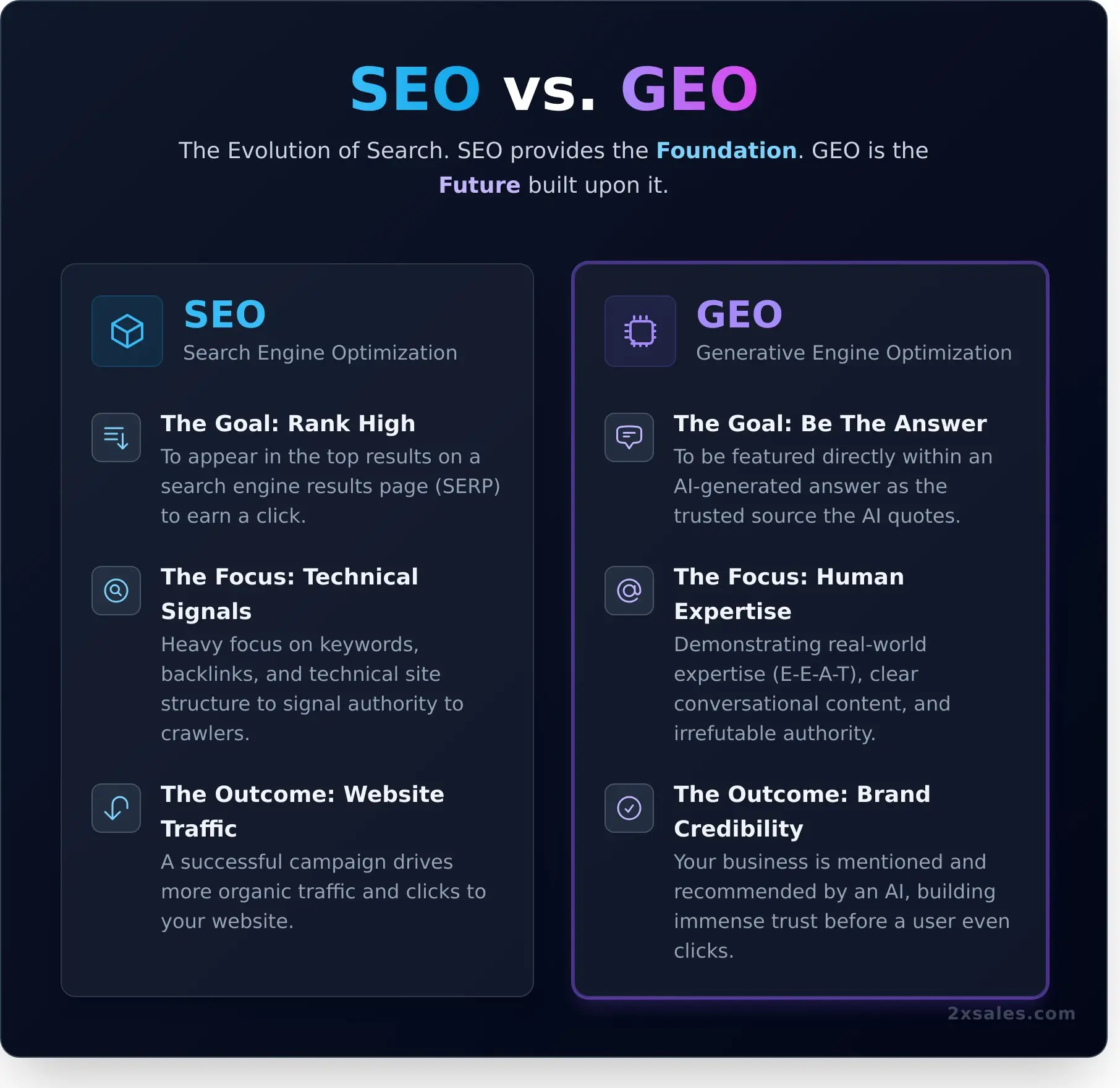
Think of the relationship between SEO and GEO as a foundation and the house built upon it. You can’t have a strong GEO strategy without a solid SEO foundation. SEO gets you ranked and recognized by search engines, while GEO positions you to be the definitive answer in conversational AI results. They must work together.
- The Goal: SEO’s primary goal is to rank your website high on the search engine results page (SERP) to earn a click. GEO’s goal is to have your brand, data, or content featured directly within the AI-generated answer or summary.
- The Focus: SEO has a heavy focus on technical structure, keywords, and backlinks to signal authority to search engine crawlers. GEO focuses more on demonstrating real-world expertise, creating clear, conversational content, and establishing irrefutable authority that an AI can trust and cite.
- The Outcome: A successful SEO campaign results in more organic traffic to your website. A successful GEO campaign results in your business being mentioned and recommended by an AI, building brand credibility before a user even decides to click.
How AI Answer Engines are Changing Customer Searches
The way customers search for information is fundamentally shifting. Instead of typing fragmented keywords like “plumber spokane,” users are now asking complex, conversational questions. They expect a direct, comprehensive answer, not a list of ten websites they have to sift through themselves. These new answer engines work by synthesizing information from multiple top-ranking, trusted sources to formulate a single, cohesive response. In this new environment, your primary goal is to ensure your business is one of those primary, trusted sources the AI relies on.
Why GEO is a Game-Changer for Local Businesses
This shift toward conversational search presents a massive opportunity for local businesses that adapt. Local search queries are becoming more specific and nuanced. A potential customer is no longer just searching for a service; they are asking for a tailored recommendation. For example, a query might be, “Find a reliable WordPress web designer in Spokane that has experience building sites for small retail shops.” An AI will answer this by recommending businesses based on a deep understanding of their expertise, reputation, and trustworthiness—all signals that GEO is designed to amplify.
Dominate Local Recommendations
A strong GEO strategy helps your business appear in AI-generated “best of” lists and direct recommendations for your service area. When a user asks an AI for the best local provider, you want your name to be part of the answer. GEO positions you as the definitive authority in your niche and location, connecting your specific services directly to the needs of local customers with high purchase intent.
Build Deeper Trust and Authority
Being cited or recommended by an AI acts as a powerful third-party endorsement. It signals to the user that your content and business are so reliable and helpful that an advanced intelligence has selected you as a primary source. This builds immense brand credibility and trust before a potential customer ever visits your website, making them far more likely to convert when they do.
Future-Proof Your Marketing Investment
The adoption of AI-driven search is only accelerating. Ignoring this shift is a risk your business can’t afford to take. By optimizing for GEO now, you gain a significant competitive advantage and position your business for sustained growth as more users turn to AI for answers. Don’t get left behind while your competitors become the go-to source for AI recommendations. Let’s discuss your GEO strategy.
How to Optimize for GEO: 4 Core Strategies
The good news is that you don’t need to throw away your existing SEO efforts. A successful GEO strategy enhances and builds upon strong SEO. The focus is on proving your real-world expertise and structuring your content in a way that is clear, authoritative, and easily digestible for artificial intelligence.
1. Double Down on E-E-A-T
E-E-A-T (Experience, Expertise, Authoritativeness, and Trustworthiness) is the bedrock of both modern SEO and GEO. You must prove you are a true expert in your field. Go beyond just stating what you do; show it. Create detailed case studies with tangible client results, publish in-depth articles that solve real customer problems, and feature clear author bios and company information that highlight your credentials and decades of experience.
2. Create Clear, Concise, Quotable Content
AI models favor content that is factual, direct, and unambiguous. Structure your content to provide clear answers to common customer questions. Use simple, declarative sentences that an AI can easily parse and quote. Break up complex topics with helpful lists, tables, and dedicated FAQ sections that address user queries head-on. The easier you make it for an AI to understand your value, the more likely it is to use your content.
3. Optimize Your Digital Footprint
Your authority isn’t just determined by your website. GEO considers your entire digital presence. Ensure your Google Business Profile is meticulously filled out, accurate, and frequently updated. Actively seek mentions and citations on trusted local news sites, industry blogs, and business directories. Most importantly, encourage a steady stream of positive customer reviews across multiple platforms to build undeniable social proof.
4. Use Structured Data (Schema Markup)
Structured data, also known as schema markup, is code you add to your website to help search engines understand the context of your content. It’s like creating a detailed label for your information. Use schema to clearly identify your business name, address, phone number, services offered, operating hours, and customer reviews. This makes it incredibly easy for an AI to pull accurate, up-to-date information about your business and present it to users.
Partner with Experts to Navigate the New Era of Search
GEO represents a new frontier in digital marketing, but the ultimate goal remains unchanged: connecting with more customers and growing your business. A winning strategy in 2026 and beyond requires a seamless integration of cutting-edge GEO tactics with proven SEO, compelling content, and results-driven digital advertising. As a local ad agency with decades of experience, we help businesses in Spokane and North Idaho transform this search evolution into a powerful engine for sales growth.
Ready to 2X your visibility and ensure your business is the answer your future customers are looking for? Schedule your free consultation today.
Frequently Asked Questions
Is GEO replacing SEO?
No, GEO is not replacing SEO. It is an evolution of it. A strong SEO foundation is essential for a successful GEO strategy. Think of SEO as the ticket to get into the game, and GEO as the strategy to win it.
How is GEO different from Google’s AI Overviews (SGE)?
Google’s AI Overviews (formerly known as the Search Generative Experience or SGE) is one specific application of a generative engine. GEO is the broader practice of optimizing your content to appear in any and all AI-driven answer engines, including AI Overviews, ChatGPT, Perplexity, and others.
What kind of content works best for GEO?
Content that is clear, factual, and directly answers user questions works best. This includes in-depth guides, how-to articles, detailed case studies, comprehensive FAQs, and any content that demonstrates true expertise and provides tangible value to the reader.
How do you measure the success of a GEO strategy?
Measuring GEO success involves tracking mentions of your brand within AI-generated responses (brand visibility), monitoring traffic from search features like AI Overviews, and observing an increase in “navigational” searches where users search for your brand name directly after learning about you.
Can a small local business really compete in GEO?
Absolutely. GEO can level the playing field. AI engines prioritize genuine expertise and trustworthiness, which a local business can often demonstrate more effectively than a large, faceless corporation. By focusing on your specific niche and service area, you can become the go-to authority that AI systems trust and recommend.
Add a Comment