

You’ve invested significant resources into a professional website. You see the traffic analytics ticking up, yet your phone remains silent and your inbox is empty. It’s one of the most frustrating positions for a business owner: watching competitors thrive online while your digital storefront fails to produce. If the thought, “my website isn’t getting leads,” is keeping you up at night, you’re not alone-and you’ve come to the right place for a solution.
Stop the guesswork. An underperforming website isn’t a lost cause; it’s a missed opportunity waiting for a targeted strategy. In this article, we cut through the noise to deliver a pragmatic, 4-step diagnostic process designed to transform your site from a passive brochure into a sales-doubling machine. You will pinpoint the exact reasons your site is failing and gain an actionable checklist to ignite growth. It’s time to claim your market share and finally see the powerful returns your website was built to deliver.
Key Takeaways
- Before blaming your marketing strategy, you must diagnose the silent technical errors that are killing your conversions.
- Learn to transform your website’s messaging from a simple description into a persuasive argument that compels visitors to take immediate action.
- The solution to “my website isn’t getting leads” often lies in your traffic quality, not just quantity; discover how to attract high-intent visitors.
- Identify the critical trust signals your site is likely missing and implement them to eliminate visitor hesitation and boost conversions.
Diagnosis 1: The Foundation – Is Your Website Technically Broken?
If you find yourself thinking, “my website isn’t getting leads,” the first place to look isn’t your marketing strategy-it’s the technical foundation of the site itself. Before you invest another dollar in advertising, you must ensure your digital storefront is actually open for business. Technical problems are silent lead-killers; potential customers encounter an issue and simply leave without a trace, costing you opportunities you never knew you had. These foundational flaws not only frustrate users but also hurt your Google rankings, making it even harder for your business to be found.
This video offers a direct overview of common website issues that hinder effective lead generation and what to do about them.
Poor Site Speed & Performance
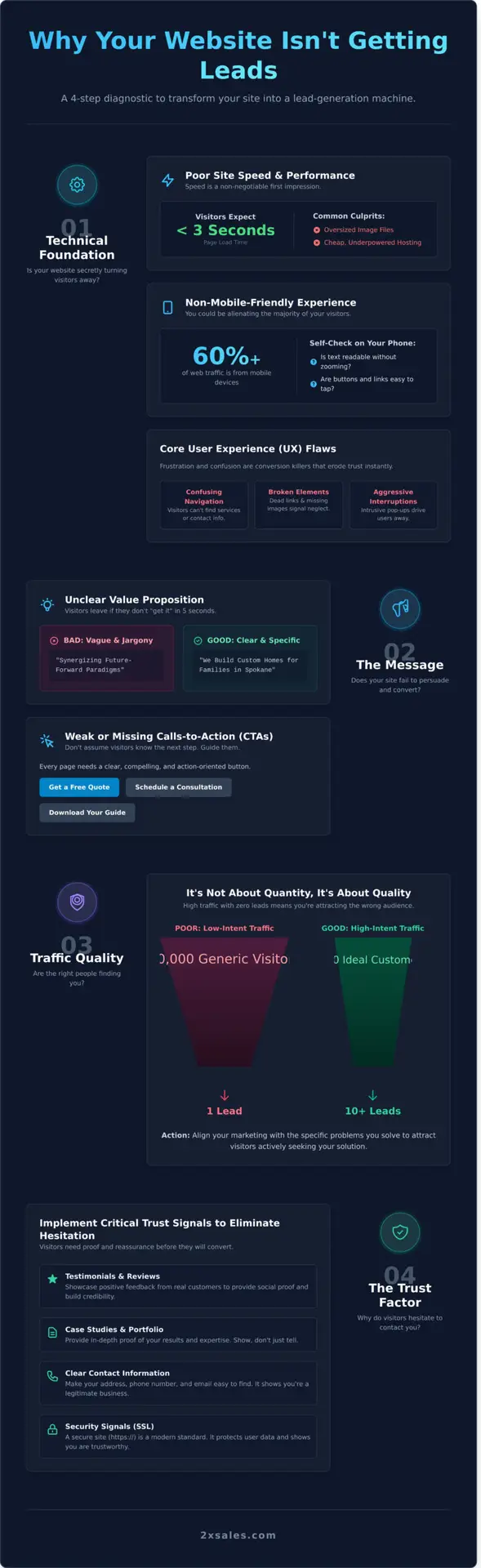
In today’s market, speed is non-negotiable. Visitors expect a website to load in under three seconds, and if it doesn’t, they’re gone. This isn’t just a lost visitor; it’s a lost sale. You can get an instant performance score using Google’s free PageSpeed Insights tool. The most common culprits behind a slow site are oversized image files and cheap, underpowered web hosting. A slow website signals a low-quality experience to users and search engines alike, directly impacting your bottom line.
A Non-Mobile-Friendly Experience
With over 60% of all website traffic now coming from mobile devices, a poor mobile experience is a critical business liability. When my website isn’t getting leads, one of the first things I check is its mobile performance. Pull out your smartphone and navigate your own site. Is the text readable without pinching and zooming? Are the buttons and links easy to tap with a thumb? If the experience is clumsy, you are actively turning away the majority of your potential customers.
Core User Experience (UX) Flaws
A poor user experience (UX) creates immediate frustration and erodes trust. If potential clients can’t easily find what they need, they won’t waste time trying. Key flaws that sabotage conversions include:
- Confusing Navigation: Illogical or cluttered menus that make it impossible to find key information like services or contact pages.
- Broken Elements: Dead links and missing images signal neglect and make your business look unprofessional.
- Aggressive Interruptions: Intrusive pop-ups or auto-playing videos that hijack the user’s focus and drive them away.
A flawed UX tells visitors you don’t value their time-the fastest way to lose a potential lead forever.
Diagnosis 2: The Message – Does Your Website Fail to Persuade?
A technically perfect website with fast load times and flawless code is still just a digital brochure if its message fails to persuade. You can have a site that checks every box for performance, but if visitors arrive and don’t immediately understand what you do, why it matters to them, and what to do next, they will leave. Your website’s copy must transform it from a passive pamphlet into an active, results-driven salesperson that guides prospects toward a conversion.
This messaging problem is often the core reason a business owner says, “my website isn’t getting leads.” A powerful message is the foundation of your lead generation strategy; it must convert the visitors you currently have. A well-crafted message also plays a crucial role in your marketing efforts, as the U.S. Small Business Administration notes that strong content attracts traffic-the very people you want to turn into customers. Let’s break down how to fix your messaging.
Unclear Value Proposition
Your visitors make a snap judgment. Can they understand what you offer, who you help, and what problem you solve within five seconds of landing on your homepage? If the answer is no, you have a messaging problem. Ditch clever, ambiguous headlines for crystal-clear statements. Instead of “Synergizing Future-Forward Paradigms,” use “We Build Custom Homes for Families in Spokane.” Avoid industry jargon and speak the language of your customer to establish an instant connection.
Weak or Missing Calls-to-Action (CTAs)
Your website’s primary goal is to generate action. You cannot assume visitors will know what to do next-you must tell them explicitly. Every page should have a clear, compelling CTA that directs the user’s journey. Use strong, action-oriented phrases on your buttons, such as:
- Get a Free Quote Now
- Schedule Your Consultation
- Download the Guide
Don’t make potential leads hunt for your contact page. Place prominent CTA buttons strategically throughout your site to make conversion effortless.
Copy That Fails to Connect
Is your website copy all about you (“we do this,” “our company has…”) or is it focused on the customer (“you get this,” “solve your problem with…”)? Effective copy addresses your customer’s pain points directly and positions your service as the definitive solution. It should build trust and demonstrate empathy. Use scannable formatting like short paragraphs, bolded text, and bullet points to convey benefits quickly. Your words are the engine of conversion; they must build a connection that compels the visitor to take the next step.
Diagnosis 3: The Traffic – Are the Right People Finding You?
You’ve invested time and capital into a professional, high-impact website, but the lead generation form remains empty. Before you blame the design or the copy, consider a different culprit: your traffic. The most persuasive website in the world is useless if no one sees it. The core issue is often not the destination (your site) but the journey people take to get there. If you’re attracting zero visitors or, just as damaging, the wrong visitors, you’ll never achieve your sales goals.
You Have a Visibility Problem, Not a Website Problem
Many business owners conclude, “my website isn’t getting leads,” when the real problem is that their site is functionally invisible. If your business isn’t optimized for search engines (SEO), you are hidden from the vast majority of your potential customers. A foundational SEO strategy ensures you appear prominently on Google search results and Google Maps when prospects are actively looking for your solutions. Without it, your competitors are capturing every lead that should have been yours. A solid SEO strategy isn’t an expense; it’s a long-term investment in sustainable lead generation.
Mismatch Between Ad Targeting and Your Landing Page
If you’re running paid ads, your traffic source is direct-but is it effective? A common, costly mistake is a jarring disconnect between the ad’s promise and the landing page’s reality. Imagine clicking an ad for “Emergency Roof Repair” and landing on a generic homepage. The visitor is confused, frustrated, and gone in seconds. This high bounce rate signals to ad platforms that your page is irrelevant, driving up costs and tanking your campaign’s performance. Your ad, headline, and landing page offer must form a seamless, persuasive message that confirms the visitor is in the right place.
Neglecting Local Search Is Costing You Customers
For businesses that serve a local community, from plumbers in Spokane to attorneys in North Idaho, dominating local search is paramount. Your ideal customers are using location-based searches like “best HVAC company near me.” To capture this high-intent traffic, your Google Business Profile must be fully optimized and active. Furthermore, your website’s service pages must clearly mention your city, state, and service areas to signal local relevance to Google. Failing to focus on local SEO means you are invisible to the customers right in your backyard. Explore our results-driven digital marketing services to ensure your business owns its local market.
Diagnosis 4: The Trust Factor – Why Do Visitors Hesitate?
You can have perfect messaging and a steady stream of traffic, but if visitors don’t trust you, they will never convert. Trust is the final, critical hurdle between a visitor and a lead. Every element on your website either builds confidence or creates doubt. If you’re thinking, “my website isn’t getting leads despite the traffic,” it’s time to audit your site for trust signals.
Your goal is to systematically remove any friction or hesitation that prevents a potential customer from taking action. A visitor who feels confident in your professionalism and credibility is a visitor who is ready to engage.
Lack of Social Proof and Testimonials
Potential customers trust what other people say about your business far more than what you say about yourself. Social proof is non-negotiable for building credibility. You must showcase evidence of your success and customer satisfaction. Displaying tangible results, such as case studies or a portfolio of examples of our work, provides immediate, powerful validation that you deliver on your promises.
Outdated or Unprofessional Design
Your website’s design is a direct reflection of your business’s quality and attention to detail. An outdated, cluttered, or slow-loading website signals that your business may be unprofessional or behind the times. This erodes trust instantly. Investing in a clean, modern, and mobile-responsive site is an investment in your brand’s credibility. A quality Spokane web design shows you’re a serious, professional operation worthy of a customer’s business.
Making It Hard to Get in Touch
If a potential lead has to hunt for your contact information, you’ve already lost their trust. Hiding contact details makes your business seem illegitimate or unapproachable. Make it incredibly easy for visitors to connect with you. A few non-negotiable rules include:
- Visible Phone Number: Your primary phone number should be clearly visible in the header of every single page.
- Clear Contact Page: Provide a dedicated contact page with your address, a map, and a simple contact form.
- Simple Forms: Keep contact forms short. Only ask for essential information-name, email, phone, and a brief message.
Fixing these trust signals is a foundational strategy. When visitors feel secure, they are far more likely to become customers, finally solving the problem of why my website isn’t getting leads.
Your Action Plan: Turning Diagnosis into Leads
You have successfully moved from analysis to diagnosis. You understand the potential reasons behind the frustrating thought, “my website isn’t getting leads,” and have identified the likely culprits. Now it’s time to execute a results-driven action plan. The key is to build momentum by tackling the low-hanging fruit-the fixes that deliver the most significant impact with the least amount of effort.
Prioritizing Your Fixes: A Simple Framework
A scattered approach yields scattered results. We recommend a strategic, four-step process to transform your website from a digital brochure into a lead generation engine. This framework ensures you fix the foundation before building the skyscraper.
- 1. Secure the Foundation: Start with any technical SEO issues you uncovered. A slow-loading site, mobile-unfriendly design, or broken contact forms are critical conversion killers. Fixing these technical roadblocks is non-negotiable and must come first.
- 2. Sharpen Your Message: Next, clarify your value proposition and strengthen your calls-to-action (CTAs). Is it immediately obvious what you do and why a customer should choose you? Make your CTAs direct, compelling, and easy to find on every page.
- 3. Build Unshakeable Trust: With a functional site and clear messaging, it’s time to build authority. Integrate social proof like client testimonials, case studies, and industry certifications. Ensure your contact information is prominent and professional.
- 4. Drive Qualified Traffic: Finally, with a high-converting website in place, you can focus on a long-term strategy for attracting your ideal customers through targeted SEO and content marketing.
When to Hire an Expert to 2X Your Leads
If you lack the time, technical skills, or strategic experience to execute this plan effectively, bringing in a professional is the most cost-effective decision you can make. The goal isn’t just to apply a quick fix; it’s to implement a comprehensive strategy that delivers a consistent and predictable return on investment (ROI).
An expert agency moves beyond simply troubleshooting a problem. We architect a complete digital solution designed for sustainable growth. If your primary focus needs to be on running your business, let us focus on growing it. Stop letting a poor-performing website drain your resources and partner with a team dedicated to doubling your results.
From Diagnosis to Dominance: Your Path to More Leads
If you’ve been thinking, “my website isn’t getting leads,” you now have a clear diagnostic framework to pinpoint the cause. Lasting success isn’t found in a single tweak but in a holistic strategy that addresses your site’s technical health, persuasive messaging, and ability to build trust with the right audience. Fixing these core issues is the only reliable path from digital frustration to consistent business growth.
Don’t let this diagnosis become just another piece of information. Turn it into action. With decades of experience serving the Spokane area, 2X Sales provides results-driven WordPress web design and SEO backed by a proven process to double sales. We transform underperforming websites into powerful lead-generation assets. Let our experts provide the strategy and execution you need to see a real return on your investment.
Your website has the potential to be your best salesperson. Let’s unlock it together. Schedule Your Free 1-Hour Consultation to 2X Your Leads and get a clear action plan for success.
Frequently Asked Questions
How long does it take to see more leads after fixing my website?
The timeline for results depends on the strategy. Implementing conversion rate optimization (CRO) fixes like clearer calls-to-action can yield new leads in as little as 30 days. Broader strategies, such as a comprehensive SEO overhaul, are a long-term investment. These foundational changes typically begin generating a consistent increase in qualified leads within 3 to 6 months. It’s about deploying the right solution for the most immediate, impactful return.
Can I fix these website issues myself, or do I need to hire a developer?
Simple updates like rewriting headlines or adding a contact form can often be done without technical expertise. However, core issues like slow page speed, poor mobile responsiveness, or deep-seated SEO problems require a professional. Investing in an expert ensures the solutions are implemented correctly and strategically, transforming your website from a cost center into a powerful lead generation asset that delivers a measurable return on your investment.
How much does it cost to fix a website that isn’t generating leads?
The investment required varies based on the complexity of the issues. A targeted conversion optimization project might range from $1,500 to $5,000, while a full redesign and SEO strategy is more significant. The key is to view this not as a cost, but as a strategic investment in your sales pipeline. A proper diagnosis from an expert will outline a cost-effective plan designed to deliver a clear and measurable return.
Is it better to invest in SEO or paid ads to get more traffic?
The optimal strategy often involves both. Paid ads (PPC) deliver immediate traffic and leads, providing rapid results and valuable market data. Search Engine Optimization (SEO) is a long-term investment that builds organic authority and delivers sustainable, cost-effective traffic over time. For businesses seeking immediate impact, we recommend a combined approach: use paid ads for quick wins while building a dominant, long-term SEO foundation for unstoppable growth.
My website is brand new. Why isn’t it getting any leads?
A new website is like a new business in an unknown location; it takes time for search engines like Google to find, index, and trust it. This initial period, often called the “Google sandbox,” can last several months. If you find that my website isn’t getting leads right after launch, it’s often due to a lack of authority and visibility. An aggressive SEO and content strategy from day one is critical to accelerate this process.
What is the single most important thing to fix on my website first?
The most critical element to fix first is your value proposition and call-to-action (CTA). Your visitors must understand what you offer and what they should do next within seconds. If your message is unclear or your CTA is weak (e.g., “Learn More” instead of “Get a Free Quote”), you are losing leads. Clarifying your offer and providing a compelling, direct next step is the fastest way to transform traffic into tangible business opportunities.