

Are you watching competitors snap up local customers while your business remains virtually invisible on Google Maps? It’s a common and frustrating position, especially when complex SEO jargon makes it feel impossible to know where to start. Many business owners feel overwhelmed, uncertain which actions will actually produce a return on their investment. The reality is, you don’t need to be a technical wizard to win. Dominating your local market begins with a firm grasp of the local seo basics-a core set of powerful, straightforward strategies designed to put you directly in front of nearby customers actively searching for your services.
This no-nonsense guide is your action plan. We will cut through the noise and provide the essential, high-impact tasks you need to execute. By the end of this article, you will have a clear strategy to secure a coveted spot in the Google Maps ‘Local Pack,’ ignite a steady stream of phone calls from qualified searchers, and drive more foot traffic directly to your location. It’s time to stop leaving money on the table and start transforming your local visibility into measurable growth.
What is Local SEO and Why Does It Matter for Your Business?
Local SEO is a results-driven digital marketing strategy designed to make your business more visible in local search results on Google. Unlike traditional SEO, which focuses on ranking nationally or globally, local SEO incorporates a critical geographic component. The entire objective is to connect your business with ready-to-buy customers in your immediate service area. For a foundational overview, Wikipedia offers a comprehensive explanation of what local SEO is and its evolution. Mastering these local seo basics is not just an option; it’s a mandatory investment for local market dominance.
The ultimate prize in local search is prime placement in Google’s “Local Pack” (or Map Pack)-the block of three business listings that appear above the standard organic results. This is the first place potential customers look when searching for products or services “near me.” Why is this visibility so critical? Consider this powerful statistic: 78% of local mobile searches result in an offline purchase. When customers search for what you offer, they have a high intent to buy, and they want to buy now.
A powerful local SEO strategy directly translates to tangible business growth. It’s the engine that drives more phone calls to your front desk, more foot traffic through your doors, and ultimately, more sales and revenue for your bottom line.
Who Needs Local SEO?
If your business serves customers in a specific geographic area, you need a targeted local SEO strategy. This is an essential investment for a wide range of business models, including:
- Businesses with a physical storefront: Restaurants, retail shops, dentists, and auto repair shops that depend on customers visiting their location.
- Service-area businesses: Plumbers, electricians, landscapers, and cleaners who travel directly to their customers’ homes or offices.
- Practitioners with a local office: Professionals like lawyers, accountants, and consultants who serve a specific local client base.
- Transportation and Tourism Providers: Think of businesses like airport transfer services or local tour guides who must be visible to travelers searching for services in their destination. You can visit Click2Shuttle to see a real-world example of a private transport service that relies on local visibility.
Understanding the Local Search Results Page (SERP)
When a user performs a local search, such as “plumbers in Spokane,” Google presents a unique results page. Understanding these local seo basics begins with recognizing the three key areas on this page: paid ads at the top, the highly coveted Local Pack, and the traditional organic results below. For local businesses, the Local Pack is the most valuable real estate on the internet.
*[Screenshot of a Google search for ‘plumbers in Spokane’ showing the Local Pack]*An example of the Google Local Pack, which appears at the top of search results for local queries.
Appearing in this block instantly establishes credibility and puts your business front-and-center, capturing the majority of clicks and calls. Your goal is to be one of those three businesses.
The Cornerstone of Local SEO: Your Google Business Profile (GBP)
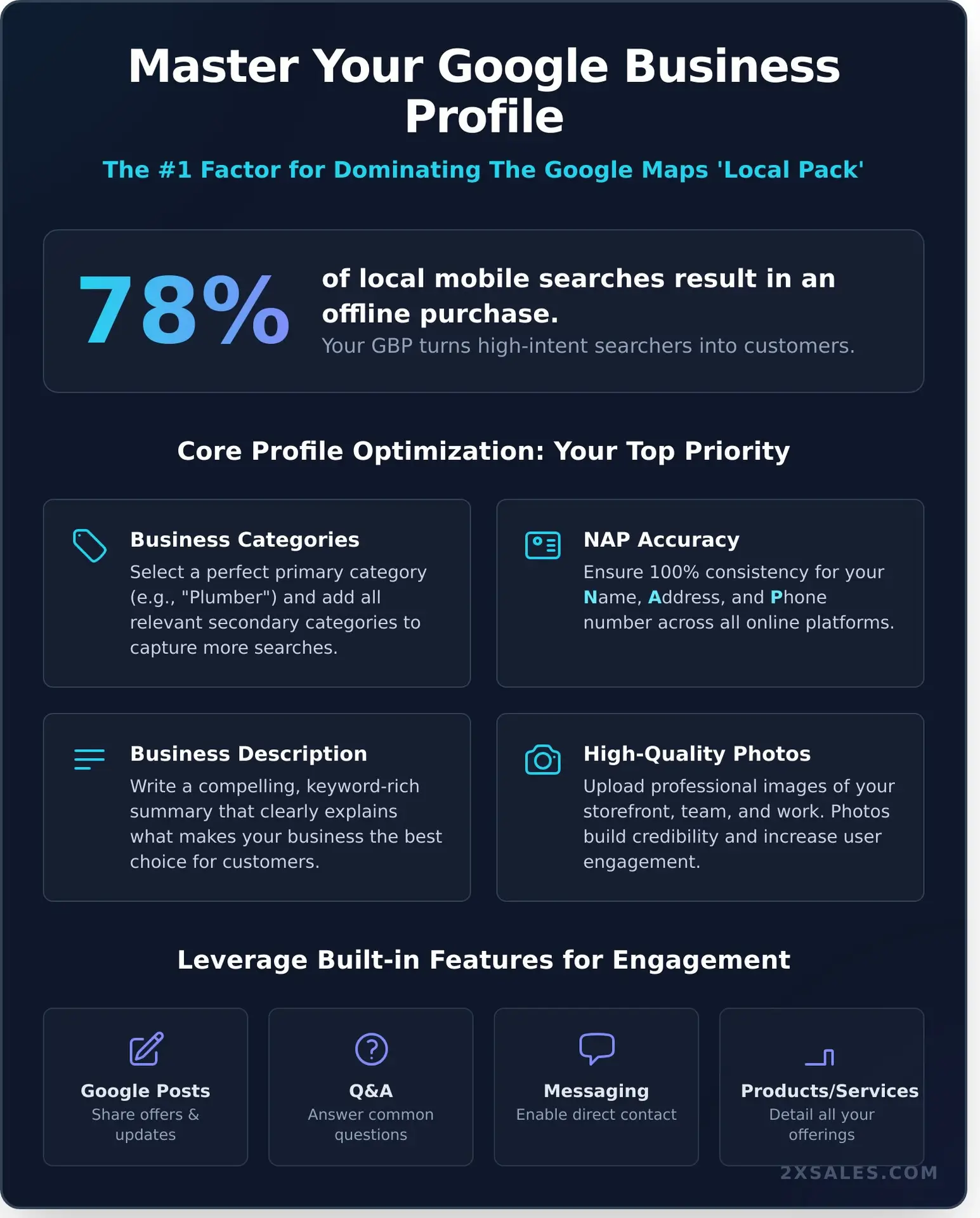
If you take only one thing away from this guide, let it be this: Your Google Business Profile is the single most powerful, results-driven tool in your local marketing arsenal. It’s a free profile from Google that acts as your digital storefront, and optimizing it is the undisputed #1 factor for ranking in the Google Maps “Local Pack.” Mastering these local seo basics begins and ends with your GBP. Claiming and verifying your profile is not just a recommendation; it is the first, non-negotiable step to achieving local search dominance.
Setting Up and Optimizing Your Profile for Maximum Impact
A bare-bones profile won’t deliver results. To transform your GBP into a customer-generating machine, you must be meticulous. Focus your initial strategy on these core components:
- Business Categories: Select a primary category that perfectly describes your main offering (e.g., “Plumber,” not “Home Services”). Then, add all relevant secondary categories to capture a wider range of searches.
- NAP Accuracy: Your Name, Address, and Phone number must be 100% consistent across your GBP, your website, and all other online directories. Inconsistencies erode trust with both Google and customers.
- Business Description: Write a compelling summary of your business. While you should include relevant keywords, the principles of clear, helpful content found in Google’s SEO Starter Guide are paramount. Explain what makes you the best choice.
- High-Quality Photos: Upload professional images of your storefront, team, products in action, and completed work. Photos build credibility and significantly increase engagement.
Leveraging GBP Features to Engage Customers
Optimization isn’t a one-time task. Google rewards active profiles. Use GBP’s built-in features to consistently engage potential customers. Use Google Posts to announce special offers, share updates, or promote events. Proactively populate the Q&A section with common customer questions and provide clear, authoritative answers. Finally, enable the messaging feature to allow clients to contact you directly from your profile, reducing friction and accelerating the sales cycle.
Showcasing Your Products and Services
Don’t make Google guess what you offer. Use the ‘Services’ and ‘Products’ tabs to explicitly detail your offerings. For service-based businesses, list each service with a clear description and, if applicable, a price. For retail, the ‘Products’ tab acts as a mini-storefront, allowing you to showcase items with photos and prices. This granular data is a powerful signal that helps Google match your business to highly specific, high-intent customer searches.
On-Page SEO Basics: Turning Your Website into a Local Magnet
Your Google Business Profile makes the introduction, but your website is the authoritative source that closes the deal. It’s the central hub that confirms every signal you send to Google about your business. The primary goal of on-page optimization is to make it undeniably clear to search engines and customers where you operate and what you offer. Mastering these local seo basics doesn’t require being a tech wizard; it demands a strategic focus on the foundational elements that drive results.
Optimizing Your Homepage and Service Pages
Your most important digital assets must scream “local.” Start with your title tags-the text that appears in the browser tab. A generic title like “Our Services” is a wasted opportunity. Transform it into a powerful local signal like “Expert HVAC Repair in Spokane, WA.” Weave your city and service area naturally into your page content. Finally, embed a Google Map of your location directly on your homepage. This is a direct, powerful signal that validates your physical address to Google.
Creating a Perfect ‘Contact Us’ or Location Page
Consistency is the currency of local SEO. Your website must feature a dedicated contact or location page that clearly displays your core business information, known as your NAP. This data is a critical ranking factor.
- Name: Your official business name, exactly as it appears on your GBP.
- Address: Your full, correct street address, city, state, and ZIP code.
- Phone Number: Your primary local business phone number.
This NAP information must be an exact mirror of your Google Business Profile-no variations. Any discrepancy erodes trust and damages your ranking potential. This page should also include your business hours and a contact form to convert high-intent visitors into leads.
Mobile-Friendliness is Non-Negotiable
The vast majority of local searches happen on a smartphone while a customer is on the go. If a potential client has to pinch and zoom to navigate your site, you’ve already lost their business. This isn’t just about user experience; it’s a core component of modern local seo basics. Google prioritizes mobile-friendly websites because that’s what users demand. A poor mobile experience directly harms your rankings and your revenue. Use Google’s free Mobile-Friendly Test tool to diagnose your site and take immediate action.
Building Local Trust: Citations and Customer Reviews
Beyond optimizing your website, local SEO success is built on your reputation across the digital landscape. This is where off-page signals-primarily citations and customer reviews-become your most powerful assets. These two pillars are fundamental to the local seo basics that Google uses to evaluate your business. Citations prove you are a legitimate, established entity, while reviews demonstrate the quality of your service to both search engines and potential customers.
What are NAP Citations and Why Do They Matter?
A citation is any online mention of your business’s Name, Address, and Phone number (NAP). Think of them as digital footprints that verify your existence and location. Google cross-references this data across countless websites to confirm your business information is accurate. Consistency is non-negotiable. A single discrepancy in your address or phone number across different platforms can create confusion and erode Google’s trust, directly impacting your rankings. Start by ensuring your NAP is identical on key directories:
- High-authority platforms like Yelp, Apple Maps, and Bing Places.
- Industry-specific directories relevant to your niche (e.g., Avvo for lawyers, Houzz for contractors).
- Local chamber of commerce and business association websites.
The Power of Online Reviews
Online reviews are a critical ranking factor and the ultimate form of social proof. A steady stream of positive reviews signals to Google that you are a trusted, high-quality business, directly boosting your map pack visibility. More importantly, the vast majority of consumers trust online reviews as much as personal recommendations. A proactive review generation strategy is not aggressive; it’s smart business. Encourage reviews by simply asking satisfied customers, providing a QR code on invoices, or sending a polite follow-up email.
Crucially, you must respond to all reviews-positive and negative. Thanking customers for positive feedback reinforces good relationships, while addressing negative feedback professionally demonstrates your commitment to service and can even win back a dissatisfied client. This is a core component of mastering local seo basics. If you’re struggling to build momentum, a repeatable system is the solution. Need a strategy to get more reviews? Talk to our experts.
Your Actionable Local SEO Basics Checklist
Theory is powerful, but results are driven by action. This checklist distills the strategy we’ve covered into a clear, step-by-step plan. Follow these foundational tasks to master the local seo basics and begin your climb in Google Maps rankings. This is your roadmap to transforming online visibility into real-world customers.
Month 1: The Foundation
The first 30 days are about building a rock-solid base. Getting these details right is non-negotiable for long-term success and provides Google with the core information it needs to trust and rank your business.
- Claim and Verify Your Google Business Profile (GBP): This is the cornerstone of your local presence. Claiming and completing the verification process proves you are the legitimate owner and unlocks all of GBP’s features.
- Complete Every Profile Section: Don’t leave any field blank. Meticulously fill out your business description, categories, services, attributes, hours, and service areas. A 100% complete profile is an immediate signal of credibility.
- Audit Your Website’s NAP and Mobile Experience: Ensure your business Name, Address, and Phone number (NAP) are displayed consistently on your website, matching your GBP exactly. Verify your site is fast and easy to navigate on a smartphone, as most local searches happen on mobile devices.
Month 2: Building Consistency and Content
With your foundation in place, the next phase is about expanding your digital footprint and building authority. These steps prove your relevance and encourage customer engagement.
- Build Foundational Citations: List your business on the top 10-15 most relevant local and industry-specific directories (like Yelp, Yellow Pages, or trade association sites). Consistent NAP across these platforms builds trust with search engines.
- Optimize On-Page SEO with Local Keywords: Add your primary city or service region to the title tags and headers of your most important website pages. For example, change “Our Services” to “Plumbing Services in Spokane.”
- Implement a Review Request Process: Actively start asking your satisfied customers for reviews. Use email, text messages, or a simple handout to direct them to your GBP listing. Social proof is a massive ranking factor.
Ongoing: Maintenance and Growth
Local SEO is not a “set it and forget it” strategy. Consistent, ongoing effort is what separates the market leaders from the competition. This simple maintenance plan will protect your rankings and fuel continued growth.
- Publish a Google Post Weekly: Share offers, updates, or blog articles directly on your GBP. This keeps your profile active and provides fresh content for Google and potential customers.
- Respond to All New Reviews (Within 24 Hours): Thank customers for positive reviews and professionally address any negative feedback. This demonstrates excellent customer service and active business management.
- Upload New Photos Quarterly: Add fresh, high-quality photos of your team, location, and work every few months. This keeps your profile visually engaging and up-to-date.
Executing these local seo basics consistently will yield powerful results. It’s a strategic investment in your visibility that delivers a significant return. Feeling overwhelmed? Let us handle your local SEO for you.
Turn Local SEO Basics into Bottom-Line Results
You now hold the blueprint for local market visibility. This guide has broken down the essentials: a meticulously optimized Google Business Profile to capture immediate attention, strategic on-page SEO to make your website a magnet for local searches, and a robust profile of citations and reviews to build unwavering customer trust. Mastering these local seo basics is no longer optional-it’s the foundational investment for sustainable growth in your community.
However, turning that blueprint into a structure that generates consistent leads requires expert execution. As Spokane’s premier local marketing experts, 2X Sales leverages decades of results-driven experience. We don’t just follow a checklist; we implement a proven process specifically designed to increase your calls, drive more foot traffic, and deliver a powerful return on your marketing investment. Our strategy is built on transforming your digital presence into your most valuable asset.
Ready to stop competing and start dominating? It’s time to 2X your local leads. **Schedule a free consultation today! ** Your next customer is searching right now-let’s make sure they find you.
Your Local SEO Questions, Answered
How long does it take for local SEO basics to work?
Local SEO is a long-term investment, not an overnight solution. While some initial improvements can be seen within weeks, achieving significant, stable rankings typically takes 3 to 6 months. The exact timeline depends on factors like your industry’s competitiveness, your starting point, and the consistency of your strategy. The goal is to build a sustainable asset that delivers consistent returns, which requires a dedicated and ongoing effort to dominate the local market.
Can I do local SEO basics for free?
You can execute foundational local SEO tasks for free, such as creating and optimizing your Google Business Profile. However, achieving a competitive edge that drives significant sales often requires an investment. Professional strategies involve paid tools for competitor analysis, citation building, and review management. While free methods establish a baseline, a results-driven approach leverages expert services and advanced tools to accelerate your growth and maximize your return on investment.
What’s the difference between local SEO and running Google Ads?
Local SEO is the strategic process of earning organic, unpaid visibility in local search results and on Google Maps. It builds long-term authority and trust with both Google and customers. In contrast, Google Ads provide immediate, paid placement at the top of search results. SEO is a marathon that builds a lasting digital asset, while ads are a sprint for generating immediate leads. A powerful marketing strategy combines both for sustained growth and immediate impact.
How do I find the right keywords for my local business?
Begin by identifying “service + location” phrases, such as “commercial HVAC in Spokane” or “emergency plumber near me.” Use Google’s search bar and see what it auto-suggests to find common queries. For a data-driven strategy, analyze competitor keywords and use professional tools to find high-intent, low-competition terms. Targeting the right keywords is fundamental to attracting qualified local customers who are ready to make a purchase.
Do I need a physical address to rank in local search?
Yes, a verifiable physical address within your target city is a non-negotiable requirement for ranking in Google’s local pack and on Maps. While service-area businesses can hide their street address from the public, it must be provided to Google for verification. Without this proof of a legitimate local presence, it is nearly impossible to compete. This is one of the most critical and foundational local SEO basics for establishing your digital footprint.
How often should I update my Google Business Profile?
Consistent activity is key to signaling relevance to Google. We recommend a weekly rhythm: publish at least one Google Post, upload new photos, and answer any new Q&As. Critically, you must respond to all new reviews-positive and negative-as quickly as possible. A monthly check-in to confirm your core business information is accurate is also a best practice. This consistent management directly impacts your local search ranking and customer engagement.
Add a Comment